The Networked Firm
The book explores temporary firms, agent negotiation and capital allocation. Swahast keeps binding authority with people and records conduct as facts without scores.
AN EXPLORATION OF WHAT COMES NEXT
Independent people. Shared objectives.
A new way to come together, create value,
and carry the experience forward.
A message can travel around the world in a second. Turning an idea into a team that can deliver it still takes interpretation, judgment, negotiation, and shared understanding.
Make communication possible across distance.
Make discovery and exchange more accessible.
Help turn an incomplete objective into a shared, executable structure.
A WORKING CONCEPT
The effort required to clarify an objective, identify the capabilities it needs, evaluate evidence, agree on commitments, and keep independent contributions aligned.
What becomes possible if AI can reduce that effort?
THE ORGANIZING IDEA
A project can end without its useful evidence, relationships,
and reusable capabilities disappearing with it.
A Networked Firm begins with an outcome. People and resources assemble around it, agree on contributions, work together, and preserve what they learn.
01 / BEGIN WITH INTENTION
Clarify the desired outcome, constraints, available resources, and what successful completion would look like.
AI may help interpret and prepare. Participants retain authority over selection, commitments, amendments, and acceptance.
SWAHAST / स्वहस्त / ONE’S OWN HAND
An open protocol for temporary collaborations. Independent people agree on contributions, share credit, resolve disputes, and carry their history into the next project.
Only people can commit. Every material assumption an agent makes must be disclosed and acknowledged before an agreement is accepted.
Published as the Networked Firm Protocol through v0.2. Swahast names the protocol; The Networked Firm remains the founding research essay.
A new name, established terminology for each party’s commitments, an explicit contribution statement, and expanded related work. The v0.2 rules carry forward unchanged; the record field and template names follow the rename.
Party positions on conflicts and intent declared before drafting are new questions for v0.4, rather than new rules.
THE CONTRIBUTION / SECTION 14
The building blocks have precedents. v0.3 states a narrow contribution in how these elements work together across a collaboration.
Agents disclose the choices they made in fixed material categories. Each material assumption must be acknowledged before the people involved consent.
Joint agreements let co-creators share obligations, approve together, and set structured credit in advance, alongside supply agreements for deliverables.
Permanent conduct facts are computed from a shared project log for owners and contributors alike. They travel with explanations and repair records, without scores or ratings.
No version has yet run on a real project. Legal enforceability, data protection, practical escrow integration and other operational questions remain open for pilots and v0.4.
Pawar, D. (2026). Swahast Protocol (Version 0.3). Zenodo. https://doi.org/10.5281/zenodo.23231563
Each release retains its own document, name and DOI.
8 October 2026 · 27 pages
Renamed from Networked Firm Protocol. Clarifies the contribution and commitments terminology, expands related work, and carries forward v0.2’s rules.
6 October 2026 · 25 pages + 4-page decisions appendix
Introduced joint mode, disclosed assumptions, a shared project log, escrow and two-way conduct. Preserved under its original published name and DOI.
Pawar, D. (2026). Networked Firm Protocol (Version 0.2). Zenodo. https://doi.org/10.5281/zenodo.23188282
Every temporary organization needs more than a list of names. It needs a shared understanding of who provides what, under which terms, and how completion is accepted.
THE CONTRIBUTION AGREEMENT
Research assistant / Evaluation methodology
Build a specialist research assistant.
Design an evaluation framework.
Independent domain researcher.
An evaluation framework, a documented test set, and a review of the assistant against the agreed criteria. Dependencies and exclusions are recorded before work begins.
The first product could be small: four surfaces that help a real project form, establish terms, and preserve accepted contributions. Work continues in the tools people already use.
Build a research assistant that helps specialists find and evaluate relevant literature.
A working prototype, a documented evaluation, and a clear account of its limitations.
Source attribution
Permitted data use
Specialist review
Inspectable retrieval
Reviewed evaluation set
Documented failure cases
A useful next question
Which capabilities and existing assets would make this objective feasible?
Start with what the outcome requires. Inspect the sources behind every capability claim.
Retrieval engineeringSource: repository · Role: maintainer
Artifact linkedDomain evaluationSource: prior project · Role: specialist reviewer
Context recordedLiterature datasetAsset: research corpus · Condition: permitted reuse
Terms to inspectResearch interfaceSource: portfolio · Role: product designer
Artifact linkedEvidence before reputation
AI interpretations stay linked to their sources and can be challenged.
Compose a feasible group of people and assets. Expose trade-offs before anyone commits.
Confirm asset licensing, reviewer availability, milestone criteria, and the process for changes.
Proposals become commitments through consent
Recommended formations and draft agreements require participant acceptance.
After closure, preserve what was accepted, which rights remain, and what can be reused.
Portable evidence, contextual judgment
A contribution record helps the next project inspect relevant experience.
One possible interface for an open protocol. This workspace illustrates the whitepaper’s proposed product surfaces; it does not implement Swahast Protocol v0.3. Early coordination can remain human assisted.
Accepted work creates inspectable history. That history can help future collaborators understand what happened, which capabilities were demonstrated, and which constraints matter.
Artifacts & provenance
Accepted contributions
Rights & reusable assets
Relationships & context
Evidence over ranking.
Context over abstraction.
Contestability over permanence.
AI can improve coordination inside firms too. The comparative question is when temporary networks can compete with the continuity, accountability, and governance of permanent organizations.
Measure the time from an incomplete objective to a mutually accepted team, unresolved capability requirements, and the human effort spent on coordination. Compare this with an appropriate existing approach.
Track agreement amendments, accepted contributions, and disputes. Test whether structured terms improve clarity around scope, rights, reward, and acceptance without creating more administration than they save.
Observe whether previous contribution records change formation decisions. Preserve source provenance, permissions, and the ability to contest errors. Evaluate whether newcomers still have viable paths into the network.
Repeated collaboration, specific investments, durable dependencies, and tacit knowledge may favour a permanent organization. A useful network should help recognize that boundary. Voluntary repeat formation is an early signal worth testing.
FROM CONCEPT TO EVIDENCE
Whitepaper v1.0
24 September 2026
Swahast Protocol v0.3
8 October 2026
Use the pilot profile.
Observe coordination and consent.
Pilot evidence and review
inform v0.4.
The model and proposed architecture have not yet been empirically validated. Temporary organizations are one possible form; their suitability depends on the work.
 OPEN THE WHITEPAPER ↗
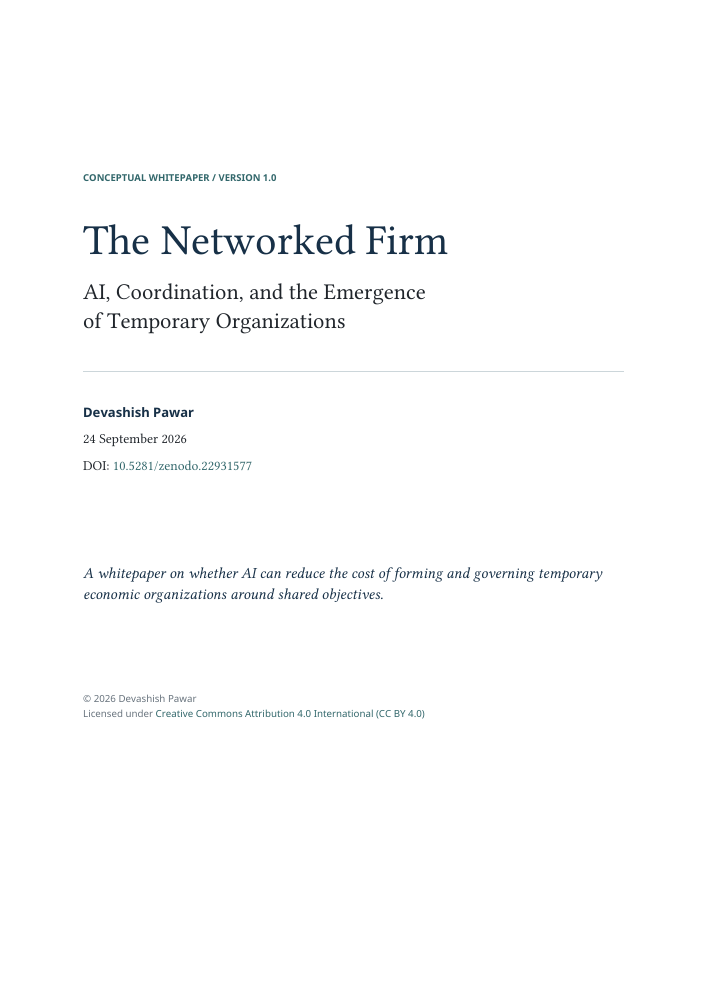
CONCEPTUAL WHITEPAPER / VERSION 1.0
AI, Coordination, and the Emergence
of Temporary Organizations
The argument, intellectual foundations, proposed protocol, limitations, and falsifiable propositions behind the concept.
Pawar, D. (2026). The Networked Firm: AI, Coordination, and the Emergence of Temporary Organizations (Version 1.0) [Working paper]. Zenodo. https://doi.org/10.5281/zenodo.22931577
The short film introduces the question.
The paper develops the argument.
A WIDER ORGANIZATIONAL DESIGN SPACE